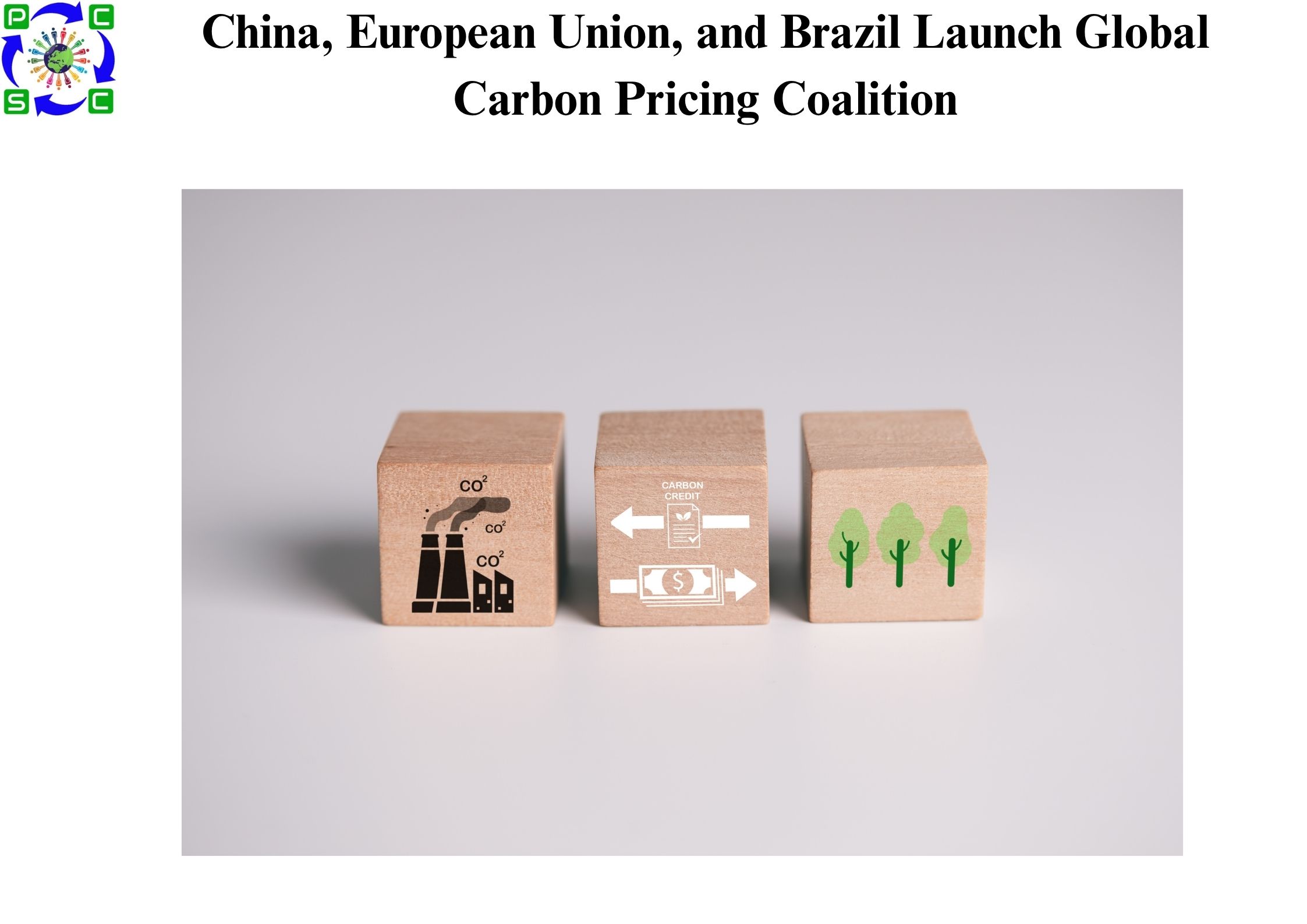
The governments of China and Brazil, along with the European Commission, have announced the launch of the Open Coalition on Compliance Carbon Markets — a new international initiative designed to strengthen global collaboration on carbon pricing.
Carbon markets are widely used by governments to support decarbonization efforts. These systems typically place a cap on emissions and require companies to hold allowances equivalent to their greenhouse gas emissions. Companies emitting less than their allocated limit can sell surplus allowances, while higher emitters must purchase additional permits, creating a financial incentive to reduce emissions. According to the European Commission, nearly 80 carbon pricing mechanisms are currently operating across 50 countries, highlighting the growing importance of international cooperation. The coalition aims to promote best practices, enhance global standards, and advance carbon pricing as a cost-effective climate action tool.
The European Union introduced its Emissions Trading System (ETS) in 2005, covering high-emission sectors such as power generation, oil refining, steel, cement, chemicals, paper, and aviation. Although the system is currently under review amid rising energy costs and geopolitical pressures, EU leadership continues to emphasize its role in reducing fossil fuel dependence, accelerating clean energy adoption, and funding decarbonization technologies.
China launched the world’s largest national ETS in 2021 as part of its climate strategy to peak carbon emissions by 2030 and achieve carbon neutrality by 2060.
More recently, Brazil passed legislation in 2024 to establish its own Emissions Trading System.
The coalition is open to countries with nationwide compliance carbon markets, including ETS programs and carbon taxes. New Zealand and Germany have been announced as the first new member countries.
Key priorities for the coalition include strengthening monitoring, reporting, and verification (MRV) systems, improving carbon accounting methodologies, and exploring the use of high-integrity carbon offsets to maintain environmental integrity. A formal work plan is expected to be adopted during the Carbon Market Conference on 15 September 2026 in Wuhan.