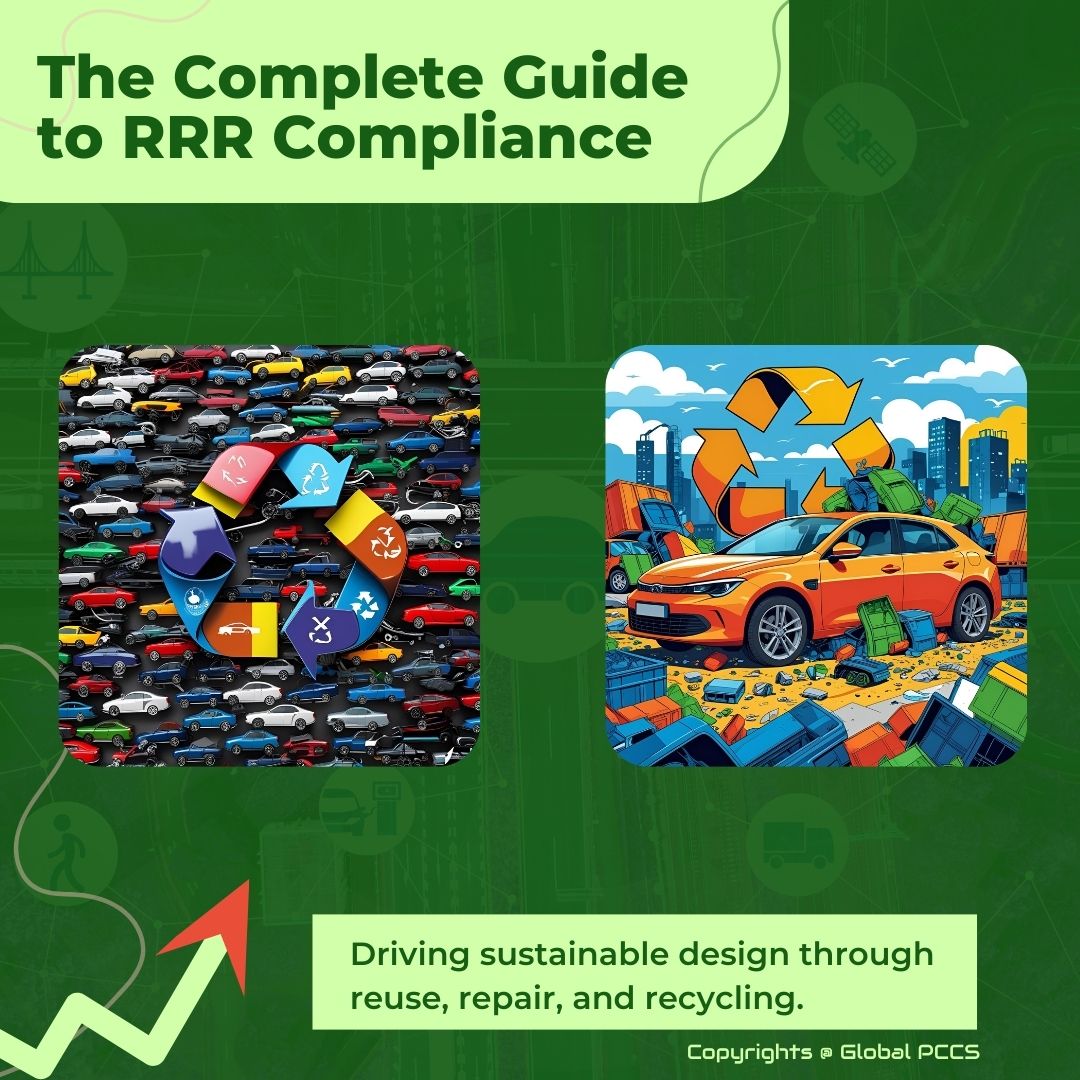
About Image

Reuse, Recycle and Recovery (RRR) as per ISO 22628

End-of-life automobiles add to the overall amount of waste that needs to be handled. Recovery concerns must be taken into account during the design stage of the road vehicle life cycle in order to guarantee ecologically sound treatment.

Designing a road vehicle now requires consideration of recycling in addition to safety, emissions, and fuel economy. New car designs and material qualities, as well as the use of proven technologies, determine recycling and recoverability rates.

Reuse, Recycle and Recovery (RRR)Services

ISO 22628 Compliance Consulting

Expert guidance to align product design and reporting with ISO 22628, the international standard for calculating vehicle recyclability and recoverability rates.

RRR Calculation & Assessment

Calculating a product's Reuse, Recycling, and Recovery rates by analyzing material composition and dismantling processes.

Data Collection & Management for RRR

Supporting the gathering, organizing, and maintaining essential material and component data for accurate RRR calculations (e.g., using IMDS).

Design for RRR (DfRR) Support

Consulting to help integrate RRR considerations into product design, optimizing for easier and more cost-effective reuse, recycling, and recovery at end-of-life.

ELV RRR Reporting

Assisting automotive OEMs with compiling and submitting required RRR data and documentation to meet End-of-Life Vehicle (ELV) directive obligations.

RRR Training

Providing workshops for internal teams on RRR principles, calculation methodologies, regulatory requirements, and best practices.

Verification Support

Assisting with the independent verification of RRR calculations, ensuring data accuracy and methodology robustness for official declarations.

Our Services Video

Watch the video to learn more about our services and how we can help you achieve your goals.

RRR Performance Metrics GPCCS

Service Image

01

Number of vehicle/component types assessed for RRR

Global PCCS has performed RRR assessments on over 150 different vehicle models and major component types, helping automotive manufacturers meet design-for-recyclability targets.

02

Average RRR rate achieved for client products

Through our RRR analysis services, clients' vehicle models consistently achieved an average RRR rate of 97%, demonstrating high levels of material recovery potential.

03

Percentage increase in RRR rate for optimized designs

Our design recommendations led to an average 3% increase in the overall RRR rate for client vehicle designs, contributing significantly to their sustainability goals.

04

Time saved for clients in RRR calculation/reporting

By leveraging our ISO 22628 RRR expertise, clients typically save an average of 80-120 hours per vehicle model assessment, accelerating their product development cycle.

05

Reduction in compliance risks (related to RRR/ELV)

Our precise RRR calculations and reporting services contributed to an estimated 95% reduction in compliance risks associated with End-of-Life Vehicle directives for our automotive clients.

WhatsApp Icon